Clear explanations of common stages in automated execution chains, including state transitions and lifecycle milestones.
Compliance-aware content
Transparent operations
Meet ypf
ypf delivers a premium snapshot of automation-centric workflows powering today’s financial-technology tools. This site offers concise breakdowns of execution pipelines, observability frameworks, and configuration governance, all framed by clarity, accountability, and a privacy-first mindset.
Data-security foundations
Audit-ready explanations
Transparent configuration
About the company
ypf furnishes educational, operations-first summaries for automation components commonly referenced in digital finance workflows. The site aims to help readers grasp typical lifecycle stages—setup, parameter definition, routing logic, and monitoring—without offering personalized guidance.
Neutral descriptions of dashboards, logs, and health indicators used for operational oversight and incident analysis.
Summaries of configuration boundaries, including session rules, constraints, and validation steps that support consistency.
Policy-guided handling practices for accounts and contact data, emphasizing access controls and retention awareness.
Our purpose
Our aim is to deliver clear, structured, and compliance-conscious insights about automation workflows within financial services. ypf concentrates on operational concepts—how systems are organized, monitored, and governed—so readers can grasp terminology, components, and process boundaries with confidence.
Focus 1
Clarify systems and responsibilities
Offer plain-language explanations of modules, ownership, and data paths within automation-oriented stacks.
Focus 2
Highlight governance
Emphasize constraints, auditing, and review routines that support accountability and oversight.
Focus 3
Promote privacy awareness
Present privacy-first handling concepts framed by policy guidance and responsible data practices.
Principles guiding our content
ypf rests on editorial and operational ideals that keep material consistent, factual, and aligned with responsible communication standards for financial services topics.
Simplicity first
We employ uniform terminology and clean layouts to explain workflows and controls in a way that remains effortless to review across devices.
Regulatory-minded writing
Content is crafted to be neutral and informative, focusing on operational concepts while avoiding personalized guidance.
Clear boundaries
We outline what the site covers and how information is organized, including policy references and explicit disclaimers.
Privacy-first mindset
We emphasize protective data practices and invite readers to review policy documentation for specifics.
Procedural discipline
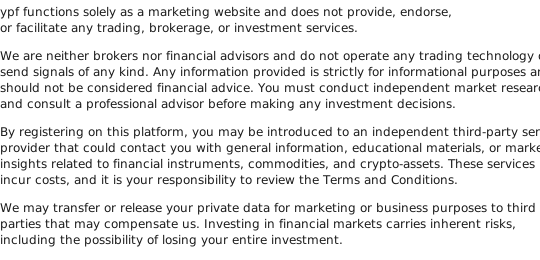
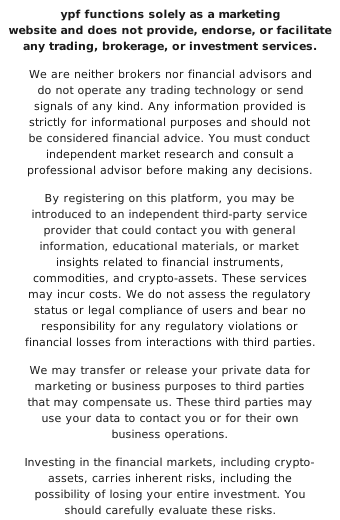
We highlight disciplined routines such as configuration reviews, session planning, and log verification as core governance practices.